

The first Christians arrived in China via the Silk Road in A.D. 635, eventually establishing a major monastery within a premier Taoist religious compound. Living side-by-side with Taoists and Buddhists for centuries, these “Religion of Light” Christians allowed their faith in Jesus to harmonise with Eastern culture. The Jesus Sutras – their long-lost scriptures – reveal a faith that centered on the “Pure Wind” of the Holy Spirit, internal stillness and breathing and movement that closely resembles foundational developments of Tai Chi.
Do these ancient scrolls provide a powerful historical “yes” to the question: Can Christians practice Tai Chi?
“The Jesus Sutras” by Martin Palmer documents how in 1907, on the extreme north-west frontier of China, a Taoist priest living a few miles outside the oasis town of Dunhuang broke into a room cut into the rocks of a remote mountain range.
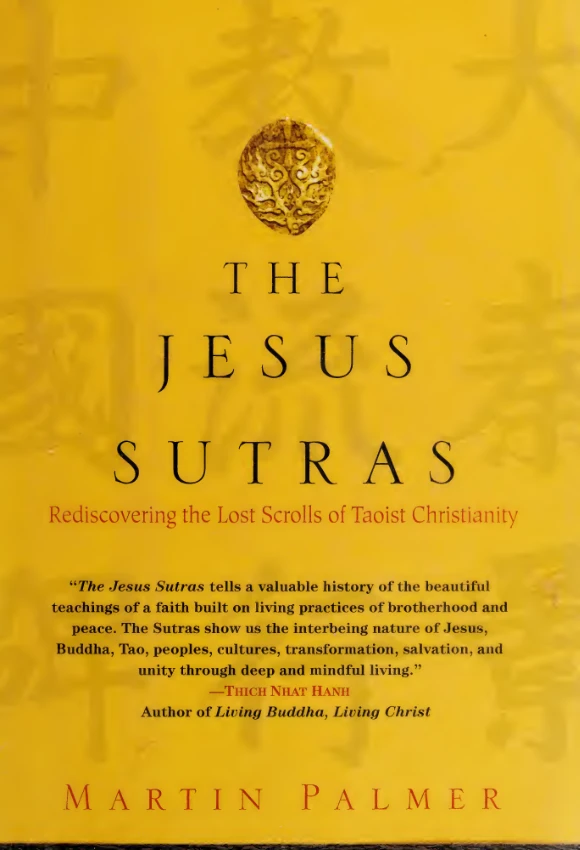
Dunhuang was once a great town on the ancient Silk Road, which stretched from the capital of China to the biblically significant city of Antioch. The room the priest had discovered was a secret library dating from the Tang Dynasty (A.D. 618-906). Inside the priest discovered a vast treasure trove of thousands of books, paintings and artifacts dating from the fifth to the eleventh centuries AD.
Most of the scrolls were Buddhist, Confucian and Taoist – the great faiths of ancient China. But carefully stored alongside these scrolls were scrolls from a faith that few knew had even existed in China at that time.
These scrolls spoke of “the Visitor,” of “the Jade-Faced One,” and of “the One Sacred Spirit.” They told of how the world began and recorded stories told by Jesus the Messiah that were, and largely still are, unknown in the West.
Palmer’s “The Jesus Sutras” documents the discovery and history of this earliest known and previously lost branch of Christianity in China that evolved between the 7th and 11th centuries – a faith that represents a unique synthesis of Christian beliefs with Eastern Taoist, Buddhist and Confucian practices.
In AD 650, these visiting Christians were permitted to build the Da Qin monastery within the precincts of Lou Guan Tai, the most famous Taoist center in China. This implies a great deal of cooperation and sharing between the first Chinese Christians and their neighbors – the early masters of Taoist movement and breath-work that represent the foundations of Tai Chi.
This cooperation is in stark contrast to the common way to interpret the history of Christianity – as one that is wrought with conflict between faiths. Of great battles between ideologies in which ancient religions and pagan beliefs were stamped out by a stronger and more forceful early Christianity that swept across Europe and ultimately conquered the world.
But what if this history is only partially correct? That often there was far more cooperation and integration between faiths and seekers of Universal Truth. The bible itself points to this with Paul’s interactions with the pagan Greeks. He may well have been disturbed by the worship of pagan idols in Athens, but he still complimented their piety when he appealed to both Jews and Greeks in the book of Acts:
“People of Athens! I see that in every way you are very religious. For as I walked around and looked carefully at your objects of worship, I even found an altar with this inscription: TO AN UNKNOWN GOD. So you are ignorant of the very thing you worship—and this is what I am going to proclaim to you.” (Acts 17:22–23, NIV)
It has long been suspected, especially in original traditional churches, that the Athenians’ sense of a higher rational divine principle was unknowingly pointing toward the true God revealed in Christ the Logos. That as the first early Christian evangelists, both Paul and John adapted Greek concepts to point to biblical truth without fully endorsing pagan philosophy.
As St Thomas Aquinas would later put it: “Every truth without exception, and whoever may utter it, is from the Holy Spirit.” Or, as it is frequently put another way: “Truth is truth irrespective of who speaks it.”
Early Christian mystics, the Desert Fathers, many Saints and those who follow a more contemplative Christian tradition have frequently alluded that Chrisitanity provides an onramp to the fulfilment of other faiths and belief systems. That as the “Alpha and the Omega” or the “Beginning and the End”, the Christ is not necessarily in conflict with other faiths and systems, rather He represents the fulfilment of every great teaching and pursuit for Truth.
This is not to say that all faiths and systems are the same. But it is to acknowledge that as the “Alpha and the Omega” the concept of the Universal Christ sits outside of the confines of mere religion and faith. That people everywhere, throughout history, have had glimmers of the enormity of the reality of the Christ – and expressed that enormity within the expressions of their existing cultures and often their faiths.
As early as 200 AD, St Justin Martyr argued that the divine Logos had scattered “seeds” throughout human history and cultures. Those he described as “virtuous pagans” such as Socrates, Plato, and the Stoic philosophers, who lived according to reason and truth were unknowingly participating in Christ and could be called “Christians before Christ” in a partial sense. Pagan myths and philosophies contained partial truths or foreshadowings that pointed toward the full revelation in Jesus.
What is clear is that the idea that pagan faiths contained elements of the Christ within them predates the concept of the Trinity as an official Church doctrine, as well as any formalised bible as canon.
This is not an heretical teaching either. The church has never refuted this early understanding of the relationship between what could be described as “proto-Chrisitan” pagan beliefs, containing elements of the Christ within them.
To the point that traditional churches value early Greek philosophy such as Aristotle’s “Natural Law” as an important foundation to understanding Christian thought, and have always included it in seminary theological syllabus from the earliest of times to the present.
Such an understanding of the nature of Christ can simultaneously hold in tension the reality of Eden as deep insight into the human condition in a way that is not necessarily in conflict with Aristotle, the Stoics and then on to evolutionary biology, genetics and even palaeontology.
Such a theology similarly encompasses without internal conflict the journey of the Magi to honour the Christ-child – the “wise men” from the East who were almost certainly pagan astrologers at a time when the sciences and mathematics were inseparable from the mystical.
As it similarly honours two obscure passages of scripture that describe the same scene (Mark 9:38-40 and Luke 9:49-50):
John said to him, “Teacher, we saw someone casting out demons in your name, and we tried to stop him, because he was not following us.” But Jesus said, “Do not stop him, for no one who does a mighty work in my name will be able soon afterward to speak evil of me. For the one who is not against us is for us.” Mark 9:38-40
Who these people were and how the truth of the Christ was revealed to them we just don’t know. But Christ’s words reinforce the sentiments of both Aquinas and Martyr and countless others who have recognised the enormity of the Universal Christ.
Nevertheless, this is in stark contrast to the ideas frequently presented in what I’m starting to call the “Angry Churches” – where the Truth of Christ is presented as being at war with just about everything else.
(Do these ‘Christians’ sound like the voice of our Father? That said, please note the cut points in this video and consider how it may have been edited in order to anger those who practice martial arts or even to paint all Christians with a specific bias and prejudice.)
These “Angry Churches” do not provide an orthodox understanding of the nature of Christ and His teachings. And as much as they may proclaim their views to be what they frequently call “theologically sound”, their ideas remain officially heretical to the original church while simultaneously perpetuating a system of thinking that imprisons Christianity and Christians on a bible-shaped island, excommunicating themselves from all other forms of Truth.
As with many kinds of heresy, there is hell to pay – because living in duality halfway between faith and reality surely and inevitably leads to some kind of “psychological split”.
That “split” appears to be a polite way of describing insanity.
Perhaps unsurprising therefore, historical evidence appears to point more towards “spiritual preparation” for the coming of the message of Christ – a theme that is repeated again and again across cultures and history.
For example, there is increasing interest in the peaceful way in which the ancient Druids of early England appear to have rapidly and universally converted to Chrisitainty – seemingly without any evidence of conflict.
While this peaceful conversion has yet to be historically proved, one popular school of thought is that the Druids fundamentally recognised the Christ as the fulfillment of their own pagan system. And that the leaders of their already fully established pagan priestly class almost universally converted, or perhaps even integrated the Christ into their system.
It’s as if they were already waiting for Him to come.
Some scholars suggest Druidic theology involved a triad of deities that made the concept of the Holy Trinity immediately recognisable. Like the Taoists, the Druids were “Guardians of Creation”. So when Christianity arrived, reportedly via St Joseph of Arimathea in some legends, it was possibly seen not as a destruction of their old ways, but as the “Light” finally arriving in the community of faith they had already built.
Later in Ireland, St. Columba, a 6th-century abbot who founded the monastery on Iona, would famously proclaim: “Christ is my Druid”. That’s because St. Columba did not see the Druidic path as an enemy to be destroyed, but as a precursor that found its ultimate fulfilment in Christ.
In another example, between 1620 and 1631, the Jumano Indians of present-day Texas and New Mexico arrived at Spanish missions asking for baptism. They claimed a “Lady in Blue” had appeared to them in the desert, teaching them about the Christ in their own language and telling them where to find the missionaries.
Inexplicably, that “Lady in Blue” was Sister Maria de Jesús de Ágreda, a 17th-century Spanish nun who is said to have “bilocated” to preach the gospel in preparation for the physical arrival of missionaries in the Americas.
When the Spanish eventually visited the Jumano, they found a people already familiar with the Gospel. Maria de Ágreda, who never physically left her cloister in Spain, provided detailed descriptions of the terrain and people she had visited during deep prayers in which she said she was taken by angels to a foreign land to baptise and to preach in the name of Christ.
Apparently, she even gifted religious items such as rosaries and chalices to the Jumano who were found to have these items of European origin in their possession without ever having previous contact with Europeans.
In 19th Century Burma, the Karen people had a prophecy regarding a lost “Golden Book” given by God, “Y’wa”. When missionaries arrived with the Bible, the Karen recognised it instantly as the fulfillment of their ancient tradition, leading to mass conversions without conflict.
As an aside, is it another mere “coincidence” that an isolated population in Burma has a name for God so immediately and strikingly similar to the name of God in the Old Testament – “Yahweh”?
Much like “Chi Roh” literally means Christ in Greek, while “Chi” itself is defined as “the fundamental, invisible life force or vital energy that flows through all living things”. Which is about as good an explanation for the concept of the “Alpha and the Omega” or the “Universal Christ” as one is likely to find anywhere.
So it is likely unsurprising then that Palmer’s “The Jesus Sutras” makes it clear that the first Christians in China explicitly identified the Tao with Christ, serving as the Eastern equivalent to the Greek concept of the Logos.
In the same way that the Gospel of John uses “Logos” or “The Word” to translate the nature of Christ for a Greek audience, the Jesus Sutras used “Tao” or “The Way” to make Christ intelligible to the Chinese.
“In the beginning was the Tao,
And the Tao was with God,
And the Tao was God.”
The first lines of The Gospel of John, Chapter 1 – (Translated from a Canton edition of the New Testament, published in China in 1911 by the American Bible Society)
According to Martin Palmer’s research, here are the fundamental tenets of this early Chinese church:
Christ as the “Great Way”
The Stone Sutra describes Christianity as the “Religion of Light” and as a path that mirrors the Tao. It states that while the truth cannot be easily named, when forced to give it a name, it is the “Great Way”. Just as the Tao Te Ching says the “Tao that can be talked about is not the true Tao,” the Sutras present Christ as the “Supreme” and “Mysterious” embodiment of that same universal principle.
The Creative Principle (Christ is the Logos and the Tao)
In Western theology, the Logos is the “Word” through which all things were made. The Jesus Sutras apply this directly to the Taoist creation model:
- The Trinity in the Tao: The Sutras state that “The Way does not have a common name”. They describe God as the “True Lord of the Void” who beats up the primordial winds to create the two vapors (Yin and Yang), essentially placing Christ at the center of the Taoist origin story.
- The Nourishing Force: Emperor Taizong praised the Christian teachings because they spoke of the “origin of things and how they were created and nourished” – the exact role of the Tao in Chinese philosophy.
The Tao of Jesus (The Four Principles)
The Messiah in these scrolls teaches the “Four Essential Principles”, which Palmer identifies as a “Taoist Christianity” this is designed to return the believer to their “Original Nature”:
- Guideline of Contentment – No Wanting: Prevent the heart from being obsessed with desire. This is not a legal prohibition against having things; it is a spiritual observation that when the heart is “obsessed,” it distorts our thoughts and damages our “roots.”
- The Guideline of Naturalness – No Doing: This is the Christian equivalent of wu wei or actionless action. It suggests we should not “put on a mask” or run after fantasies, but instead be our “most natural” selves. The practice of wu wei rejects our need to control, moves in harmony with God and is the lived embodiment of “Let thy will be done”.
- The Guideline of Humility – No Piousness: Doing good without the need for a reputation or broadcasted virtue. This encourages doing what is right because it is the “Way of Light,” not to build a reputation. It’s about being like the Earth, which gives life without asking for credit.
- The Guideline of Non-Judgment – No Truth: This is perhaps the most “mystical” guideline. It suggests we should not “take sides” in arguments about “right and wrong” but reflect the world like a “clear mirror” that reflects everything without judgment.
These aren’t legalistic rules that you can check off a list. Rather they are the qualities of the “Pure Wind” (the Spirit) flowing through you. The book emphasizes that these principles “cannot teach you in themselves,” but following them frees you from “trying to sort out what to believe.”
This is the heart of Christian mysticism: moving past the head and into the direct, embodied experience of Christ.
Returning to the Source
The Sutras present Jesus as a “Dharma King” or “Visitor” who provides a “raft of salvation” to ferry souls across the ocean of life and death, breaking the cycle of rebirth or reincarnation in Buddhism. This presents Jesus as the ultimate source of internal peace and balance.
The ultimate goal of the “Religion of Light” was for the believer to reach the “other shore” and be united with the Spirit. They believed that because Christ as the Tao took on human form, the “poisons of the world” could be stopped, allowing the soul to return to its original, pure state.
The Sutras emphasise that we are saved by returning to our “True Original Nature” – a state free from falsehood and illusion. They teach that the Messiah “freed us of the karma of our lives” to bring us back to this innate purity. This mirrors the Tai Chi journey of stripping away tension and ego to find the natural, God-given balance within.
Consequently, these early Chinese Christians modified the concept of “Original Sin” in favor of “Original Nature” – the idea that humanity is innately good but becomes obscured by worldly desire. They taught that humanity possesses an “Original Nature” of innate goodness that becomes obscured by desire and “the glitter and the gold”. They point to prayer and practices like early forms of Tai Chi as a way to peel back those layers, expose them to the Light of Christ and return to the “pure and simple goodness” God originally intended.
Jesus as the Scaling Ladder: In the Sutra of Returning to Your Original Nature, the Messiah is described as a “scaling ladder” and “steps cut in stone”. Jesus is seen as the saviour that helps the “crippled” or spiritually stuck person reach the summit of “peace and happiness”. This suggests that our spiritual “climb” is supported by His strength.
The “Pure Wind” (Chi): The Sutras refer to the Holy Spirit as the “Cool Breeze” or “Pure Wind”. They taught that all living things exist only because these “Winds” give them life and that the human heart is created by this movement. This is an exact theological parallel to the concept of Chi in Tai Chi further emphasising that this early Chinese Christian Church considered Chi as one in the same as the Holy Spirit.
Because they believed the Spirit was a moving force, their worship had to be “embodied” to match that movement. Their faith was in their breath, which they believed was the “life-giving breath” of God. They believed that the body is a temple of the “Pure Wind” and that moving your hands and focusing on your breath is a way to “purify your heart”.
Importance of Stillness: The Stone Sutra explicitly states: “We use stillness to build our foundation”. It teaches that by being “pure and still,” one becomes open to the truth and can intuit the workings of the universe.
Embodied Worship: Palmer notes that ancient Christian art from this period shows figures using mudras (sacred hand gestures) to signify spiritual insights. Their faith was not just in their heads, it was in their hands and their breath, suggesting that their worship was an embodied, physical experience rather than just an intellectual one.
The “Great Persecution”
The first Chinese Church and the “Religion of Light” eventually fell victim to shifting political tides in China. While the church reached its golden age in the late 8th century, a “Great Persecution” was launched in A.D. 845 by the imperial court.
Originally targeted at the wealth and power of Buddhist monasteries, the edict ultimately swept up all “foreign” religions, forcing three thousand Christian and Zoroastrian monks to return to lay life so they would not “adulterate the customs of China”.
By the mid-11th century, the great Da Qin monastery sat deserted, leaving only a “lonely pagoda” standing stark against the mountains. While the formal institution vanished, the Jesus Sutras remained hidden for nearly a millennium in a sealed cave at Dunhuang – preserving the history and legacy of a flourishing Eastern Christianity that integrated Christ as both the Logos and the Tao and recognised that the “Pure Wind” of the “Holy Spirit” is fundamentally synonymous with “Chi”.